Patient Information

We’re Here to Help!

OK, so your dentist has told you that you need a root filling, and you are not sure what is involved and whether it is all worth it.

Smile_DSC07359

Well, yes it is worth it in most cases.  We at Ivanhoe Specialist Endodontics do care about what we do and strive very hard to be excellent at it.  No one will pretend that having endodontic treatment is great fun.  But most people find treatment is quite tolerable, and usually works out well.  The tooth is usually saved.  Losing even a back tooth leaves a gap which can make chewing slower and less of a pleasure, and may allow other teeth to tilt over.  This can disrupt the way you bite and give you pain in the jaw joints and muscles.  Of course if the tooth is a front tooth, we don’t need to tell you why it’s important to save it.  There is economic sense in saving the tooth too.  While removing a tooth is very easy and relatively cheap, replacing it with a fixed artificial tooth (e.g. a bridge or an implant) is often as much hassle and more expensive than saving the original tooth with root canal therapy.  So why not save the natural tooth if it is possible?

Some teeth can’t be saved and we try very hard to identify those cases before we start or early on in treatment.  If it isn’t likely to work out then we don’t want you to waste your time and money, so as soon as we know, we will try to advise you not to proceed or abort early on.  Because of our careful assessment, early loss of a tooth after completion of endodontic treatment is rare.  However, the occasional disappointment is far outweighed by all the many teeth we do save, so do let us try to save your tooth. We probably can.

Will It Hurt?

Many patients worry about whether treatment will be painful or difficult, and so are often very nervous to come to see us.  We understand this and do everything possible to make treatment easy.  To make the treatment easy we use strong local anaesthesia where needed and so the area is well numbed.  But as you might imagine, once a tooth is dead, then often later treatment can be done painlessly without anaesthesia.  This makes sense doesn’t it, and it’s nice to avoid a numb face when one isn’t necessary.  Many patients are surprised they don’t always need anaesthesia.

Relax_IMG_9427

It is normal that for the next day or two after treatment some mild soreness can occur in most patients, but this is usually managed easily with routine analgesics (painkillers) which can be bought at the supermarket or chemist.  You may have them at home already for headaches.  Ibuprofen 400 mg (e.g. NurofenTM) or Paracetamol (e.g. PanadolTM) every four to six hours are usually all that are required.  (Use only as directed. Incorrect use could be harmful. Consult your health care practitioner if pain or symptoms persist.) Only a few percent of patients may get more serious soreness and need stronger analgesics or antibiotics if the infection flares up.  Generally soreness only occurs for a few days after the first treatment session, goes away quickly, and doesn’t reduce the chances of saving the tooth. So don’t worry if there is a bit of soreness after the first visit. This is normal and usually slight.

What Is the Problem? – Infection Inside the Tooth

Teeth have little spaces inside called pulp spaces.  In health, these contain soft tissue (the pulp, the “nerve”).  This tiny bit of tissue is much more than just nerve and in childhood actually built most of the tooth.  In adulthood, the pulp helps the tooth feel foods that are too cold or hot and tells you with pain when the tooth is unhealthy.  The pulp space extends into a long and thin tube into the root of the tooth and so that part is called the root canal.  Next I’ll explain what happens with an endodontic infection.  It may surprise you how serious it sounds, and it is serious.  This is why infected teeth should be treated sooner rather than later when there’s more chance of getting a good result. So here goes.

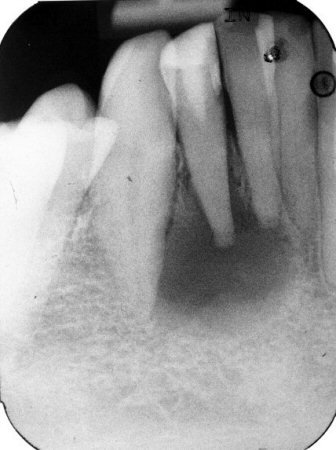
Everyone has bacteria in their mouths which usually cause no problem.  But when these bacteria get inside the tooth through cavities or cracks or under old fillings into the pulp space, they cause damage. Finally, the bugs can kill off the pulp tissue.  The pulp’s death can be very painful particularly with hot and cold foods, or amazingly you may not even notice your tooth die.  There’s so much variation between patients. Eventually bacteria get right down the root canal and come out of the end of the root into the jaw bone. Delightful!  Not surprisingly, this makes the bone around the root’s end sore.  So as you bite, the tooth is pushed into this sore bone and you feel a dull pain – even though the tooth is already dead.  Next, the bone around the end of the root then begins to dissolve away.  If pus forms in this bone hole then you have a dental abscess, which can be very painful at first.  Finally, the pus burrows a tunnel through any remaining jaw bone to the gum surface and leaks out into your mouth through a pimple on your gum. As unpleasant as this sounds, it’s similar in principle to drainage of pus from a skin acne pimple, and everyone is familiar with that.  So an endodontic infection in some ways is like with acne spot, with the final pressure release reducing the pain. Many people may think that the problem has gone away.  But unlike acne, the problem does not go away and most people are unaware that they still have a hole in their gum leaking pus.  The infection can stay there for years if not treated, with more jaw bone dissolving over time.

So why can’t the body cure the infection like it does with acne?  The difference is that with acne the pimple is all in soft tissue, so white blood cells can move in to the region and reclaim it from the bacteria. With a dental infection, the infected pulp space is surrounded by hard tooth. The white blood cells can not get back inside there to kill the bacteria. For the same reason, antibiotics carried in the blood stream can not get in either – there’s no blood supply flowing into the dead tooth anymore. Antibiotics can make the living bone outside the tooth feel healthier for a week or two, but this is just temporary. An infected tooth can not be cured with antibiotics you swallow.  Only physical treatment to clean out and medicate the tiny pulp space inside can save the tooth.

Phew, you’ll be glad that bit is over. But we like to tell it as it is so that everyone understands what we’re up against and how best to fix it.

How Do We Fix the Problem? – Remove the Bacteria

The solution is simple in principle.  If we remove the bacteria from inside the tooth, and stop new bacteria from entering, then there will be no more infection.  Bacteria will stop leaking out of the end of the root and the surrounding bone will usually grow back again.  Any pus drain holes will heal up and the tooth will feel normal again on biting.  The clean dry space inside the tooth is then filled with a type of rubber (the “root filling”) and the hole into the tooth is sealed off very well to make sure that no new bacteria get back inside.  This sealing off is really important for a long term result.  Despite being simple in principle, in practice the treatment is complex and time consuming because the root canals are very small and difficult to get into.  Some of the spaces we can clean out are less than a tenth of a millimetre across. As specialist endodontists we have special equipment to make this treatment easier. The most help comes from a microscope that can see deep down into your tooth with good lighting.  This is very useful indeed. Amazing. Also, endodontists tend to be very fussy people who insist on getting everything right, if it is at all possible.  This diligent attitude is as important as having the extra equipment and specialist training.

ToothAnatomy_8 ToothAnatomy_8_PAP ToothAnatomy_8_PAP_Prep ToothAnatomy_8_RF ToothAnatomy_8_RFCrown

If you feel that you might have an infected tooth, then we at Ivanhoe Specialist Endodontics would like to help you keep your tooth.  All you need to do is to get your general dentist to refer you to our practice, using our referral form.

Leave a Reply

118 Waterdale Road, Ivanhoe, Melbourne, Australia 03 9499 6699